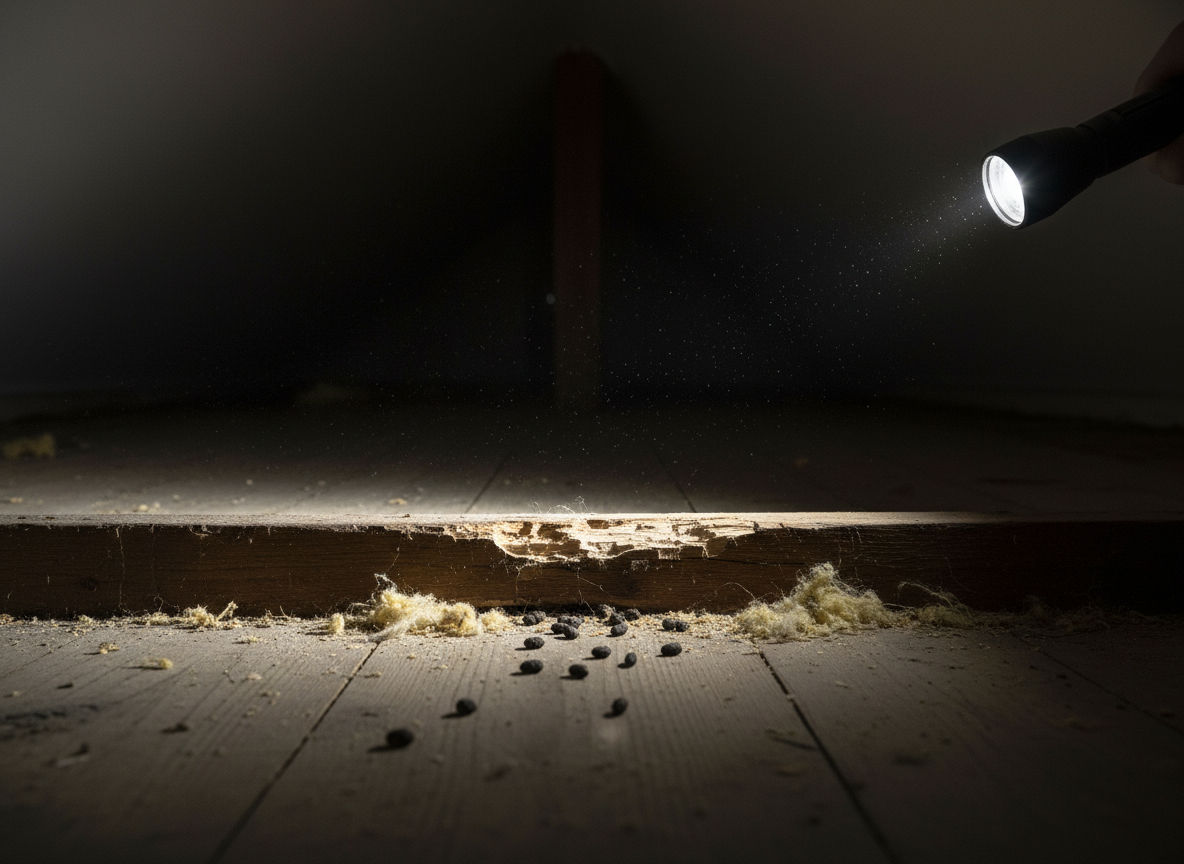
Hearing strange noises at night? A scratching, scurrying or gnawing sound from above your ceiling is one of the most common reasons homeowners in Crawley and West Sussex call a pest controller — and in many cases, it turns out to be rats in the loft. Here's how to identify a rat infestation in your loft space, and what to do about it before the problem gets worse.
Quick summary: 6 signs of rats in your loft
- Scratching or scurrying sounds at night
- Rat droppings along joists or near water tanks
- Disturbed or shredded loft insulation
- Gnaw marks on timbers, cables or pipes
- A strong ammonia-like smell
- Greasy smear marks along joists or rafters
The 6 key signs of rats in your loft
1. Scratching or scurrying sounds at night
Rats are nocturnal, so you're most likely to hear them after dark. The sounds are typically scratching, scurrying or gnawing — often in short bursts as they move around the loft space. If it sounds like something is dragging itself across your ceiling or running along a fixed route, that's a strong indicator of rats rather than mice (which tend to be lighter and faster). Hearing scratching in the loft at night is one of the most reliable early warning signs of a rat infestation.
2. Rat droppings in the loft
Rat droppings are dark, capsule-shaped and roughly 1–2cm long — significantly larger than mouse droppings. You'll typically find them along the routes rats travel: near the eaves, around water tanks, along joists and near any food sources. Fresh rat droppings are dark and moist; older ones dry out and become grey.
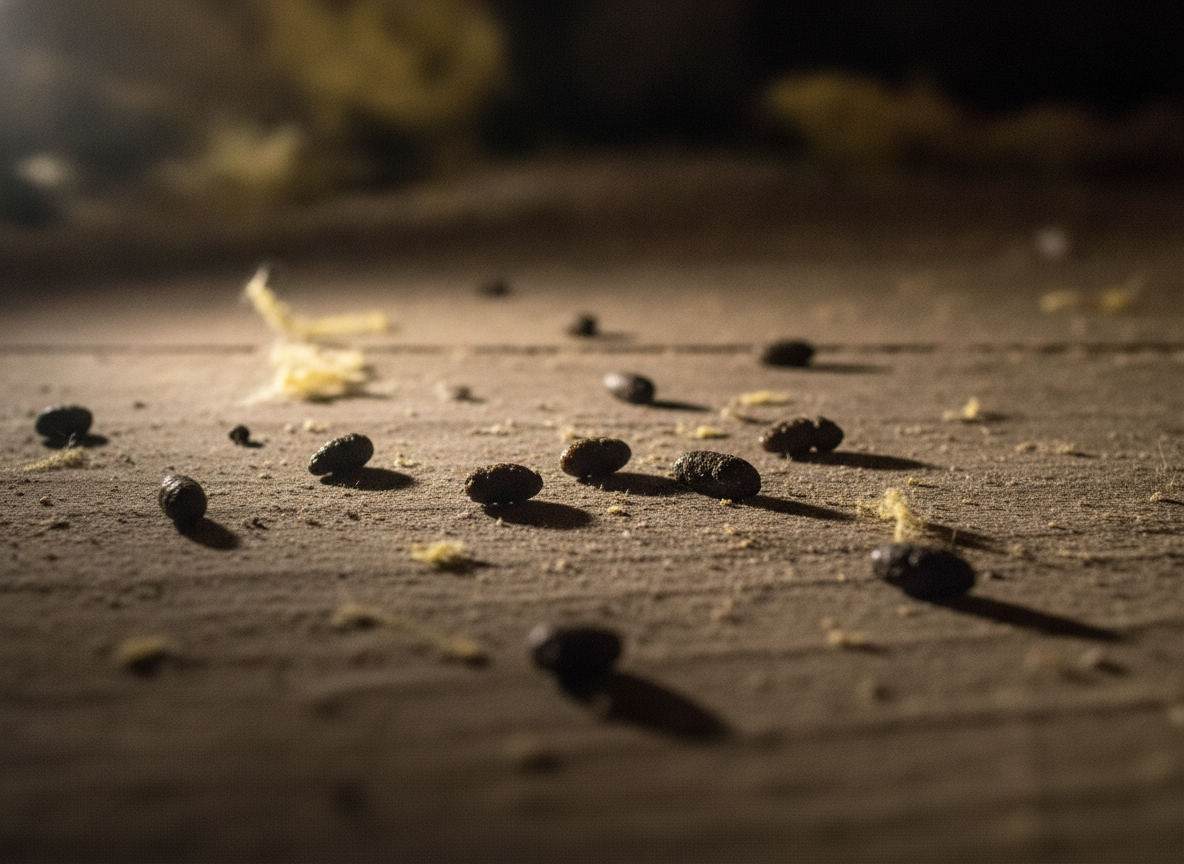
Rat droppings are 1–2cm long, dark and capsule-shaped — much larger than mouse droppings
3. Disturbed or shredded loft insulation
Rats nest in loft insulation, pulling it apart to create warm, sheltered areas. If you notice areas of insulation that look disturbed, flattened or shredded into small pieces, this is a strong sign of rat nesting activity. This kind of damage to loft insulation is a classic indicator of an established rat infestation.
4. Gnaw marks on timbers, cables or pipes
Rats gnaw constantly to keep their teeth in check. Look for gnaw marks on wooden joists, plastic pipes, cable insulation and any stored items in the loft. Gnawed cables are a serious fire hazard — one of the key reasons to deal with a rat problem in your loft quickly. If you spot chewed electrical cables in your loft, treat it as urgent.
5. A strong, unpleasant smell
A musty, ammonia-like smell in the loft or coming through the ceiling can indicate rat urine. In heavier rat infestations, you may also notice the smell of deceased rats — particularly in hard-to-reach areas of the roof space. This smell is distinctive and often the first thing homeowners notice before they investigate further.
6. Grease marks along joists or rafters
Rats follow the same routes repeatedly, and their fur leaves greasy smear marks along the surfaces they travel. Look for dark, greasy marks along the tops of joists, around holes and along the eaves. These ‘rat runs’ are a reliable sign of regular rat activity in your loft.
How do rats get into lofts?
Rats are excellent climbers and can squeeze through gaps as small as 25mm — roughly the size of a £1 coin. In Crawley and across West Sussex, common entry points into loft spaces include:
- ✓Gaps around pipes where they enter the roof space
- ✓Damaged or missing roof tiles
- ✓Gaps in soffits, fascias or barge boards
- ✓Open or poorly sealed roof vents
- ✓Gaps around cables or aerials entering the loft
- ✓Climbing up drainpipes or ivy to reach the roofline
Are rats in lofts dangerous?
Yes — a rat infestation in your loft poses several serious risks:
- ⚠Fire risk from gnawed electrical cables
- ⚠Structural damage to insulation, timbers and pipework
- ⚠Contamination of water tanks and stored items with rat urine and droppings
- ⚠Health risks from Weil's disease (leptospirosis) and other rat-borne pathogens
- ⚠Rapid population growth — a pair of rats can produce dozens of offspring within months
What should you do if you suspect rats in your loft?
Don't wait. Rat populations grow quickly — a pair of rats can produce dozens of offspring in a matter of months. The longer a rat infestation in your loft is left untreated, the more damage they can cause and the harder it becomes to resolve.
- Don't go into the loft alone — if you're not sure what you're dealing with, it's safer to get a professional rat control assessment first.
- Contact a local pest controller — a qualified rat control technician will inspect the loft, identify entry points and recommend the right treatment approach.
- Don't use shop-bought poison without advice — incorrectly placed rodenticide can cause secondary poisoning in wildlife and pets, and may not resolve the rat infestation.
- Seal entry points after treatment — once the rat infestation is treated, sealing entry points is essential to prevent re-infestation. This is the prevention-first approach PestSeal takes on every job.
Need rat control in Crawley or West Sussex?
PestSeal provides professional rat control across Crawley, Horsham, Redhill, Reigate, Horley, Gatwick and surrounding areas in West Sussex and Surrey. Weekend appointments available. BPCA qualified. 10 years' experience.